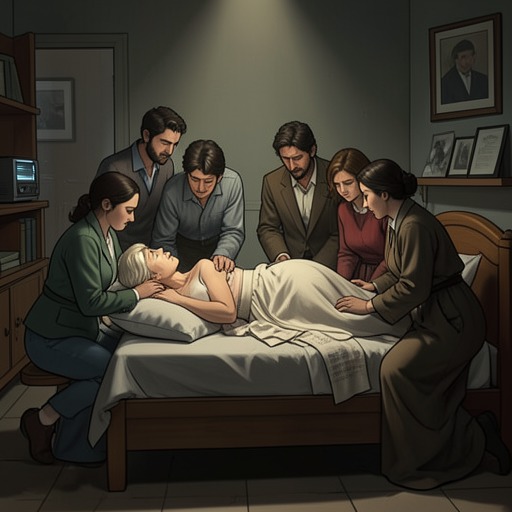
Bewildered spirits
Life After LifeBewildered spirits are figures described by several people reporting near-death experiences as caught in a confused, diminished state between physical and spiritual existence. In the accounts Raymond Moody presents, their apparent attachment to earthly people, objects, or habits leaves them unable to move forward; they seem searching and distressed, yet unable to identify what they seek. The reports do not establish a single literal geography or a universal sequence of experience: Moody treats the figures as an uncommon element in a collection of accounts, and the witness descriptions remain analogical and uncertain.
Place Among the Reported Experiences
Moody introduces these beings as one of several unusual elements reported by more than one person after the completion of Life After Life. Apart from supernatural rescues, the unusual elements discussed in this part of the book came exclusively from reports of encounters of extreme duration. The spirits are therefore not presented as part of every near-death experience, nor as a feature of the common model experience. They belong to a less frequent stratum of testimony assembled from individual accounts.
That distinction matters to the way the material is framed. Moody first summarizes recurring features as a theoretical model, but his discussion of new elements emphasizes that they are less common and arise from particular reports. The accounts of bewildered spirits are thus evidence of what some witnesses say they encountered, not a claim that every person approaching death sees the same realm or beings. Their descriptions also preserve uncertainty: witnesses struggle to say where the figures were, what they were, or how much they perceived.
Appearance and Apparent Condition
One woman, whom Moody says was believed dead for about fifteen minutes, described passing through a dull area in contrast to the brilliant light elsewhere in her experience. The figures there seemed more humanized than other beings she had seen, but were not quite in human form. She recalled bent heads and sad, depressed expressions, and compared their movement to shuffling. They appeared washed out and gray, as if drained of color; she could not even be sure that she had noticed feet.
Their motion gave the scene its peculiar aimlessness. The woman saw them move continually but in no clear direction, veering from one side to another and apparently searching without knowing what they sought. They did not look up as she passed. Their downcast posture and crushed expressions suggested to her neither purposeful travel nor rest, but a state of bewilderment and hopelessness. In her account, the figures seemed to have lost any sense of who they were or what they were.
The same witness placed the gray region after she had left the physical hospital and before entering the tunnel and the brilliant spiritual light. She contrasted its dingy, washed-out tones with the brightness that followed, describing it as resembling a black-and-white movie rather than a world of color. The figures showed no sign of noticing her, and the scene struck her as depressing. Another report, summarized by Moody, likewise describes beings who seemed dulled in consciousness and unable to surrender their ties to the physical world. Their condition appeared temporary: they would remain in it, the witnesses thought, until whatever difficulty held them there was resolved.
Attachment, Uncertainty, and the In-Between
Moody’s summary links the figures’ confusion to attachments that still bind them to earthly life. One man thought that the spirits he saw could not progress because what they loved remained in the world of the living. In Moody’s account of the pattern, the attachment might concern a particular object, person, or habit. This is an interpretation reported by witnesses, rather than a clearly observed mechanism: the figures’ posture and apparent distress suggest a bond, but do not reveal exactly what sustains it or how it might end.
The woman’s description makes that uncertainty especially pronounced. Asked whether the beings were aware of the physical world, she thought they seemed aware of neither the physical nor the spiritual realm, but caught somewhere between the two. At the same time, she wondered whether some might be looking down toward the physical world or toward something left undone. They appeared unable to decide whether to continue onward or return to the bodies below, yet the witness could not determine what they were deciding or seeking. Their state is defined as much by this failure of orientation as by any fixed location.
Failed Contact and Narrative Significance
Some reports add an attempted connection with the living. One man said he had seen a spirit hovering over an ordinary man walking down a street. He felt that the spirit might have been the living man’s mother, still unable to give up her earthly role and trying to tell her son what to do. The identification and motive are explicitly impressions, not confirmed knowledge: the witness inferred a relationship from what he saw, and could not establish what the spirit intended to communicate.
A woman described another possible attempt at contact: a figure seemed to be trying to reach children and an older woman in a house. The children continued playing, while the older woman went about her work in the kitchen, unaware of the presence. The witness wondered whether the figure had been the children’s mother and the older woman’s daughter. In her broader account, such beings seemed to try to make contact, but the living neither perceived them nor responded; there was no apparent way for the figures to break through.
These failed encounters sharpen the reports’ central contrast. The beings are imagined as still turned toward earthly attachments, but the people toward whom they turn remain unaware of them. Their apparent longing does not restore communication or give them a clear route forward. As a recurring but uncommon element in Moody’s collected testimony, the bewildered spirits give visible form to unresolved attachment and disorientation while leaving the witnesses’ explanations provisional: the accounts describe a distressing condition, not a settled doctrine about its cause or duration.